

A- A A+
Projekt RESET

Knowledge

Inherited bone marrow failures (IBMFs) are rare diseases that are life-threatening due to the risk of transformation to myelodysplastic syndrome/acute leukemia or death from complications of the disease itself.

The clinical presentation of diseases in this group is highly variable, making early diagnosis difficult. Diagnosing IBMFs is complex and requires the use of advanced molecular biology methods. Increasing knowledge about IBMFs, particularly among pediatricians, pediatric oncologists, and hematologists, will allow for early diagnosis and targeted treatment.

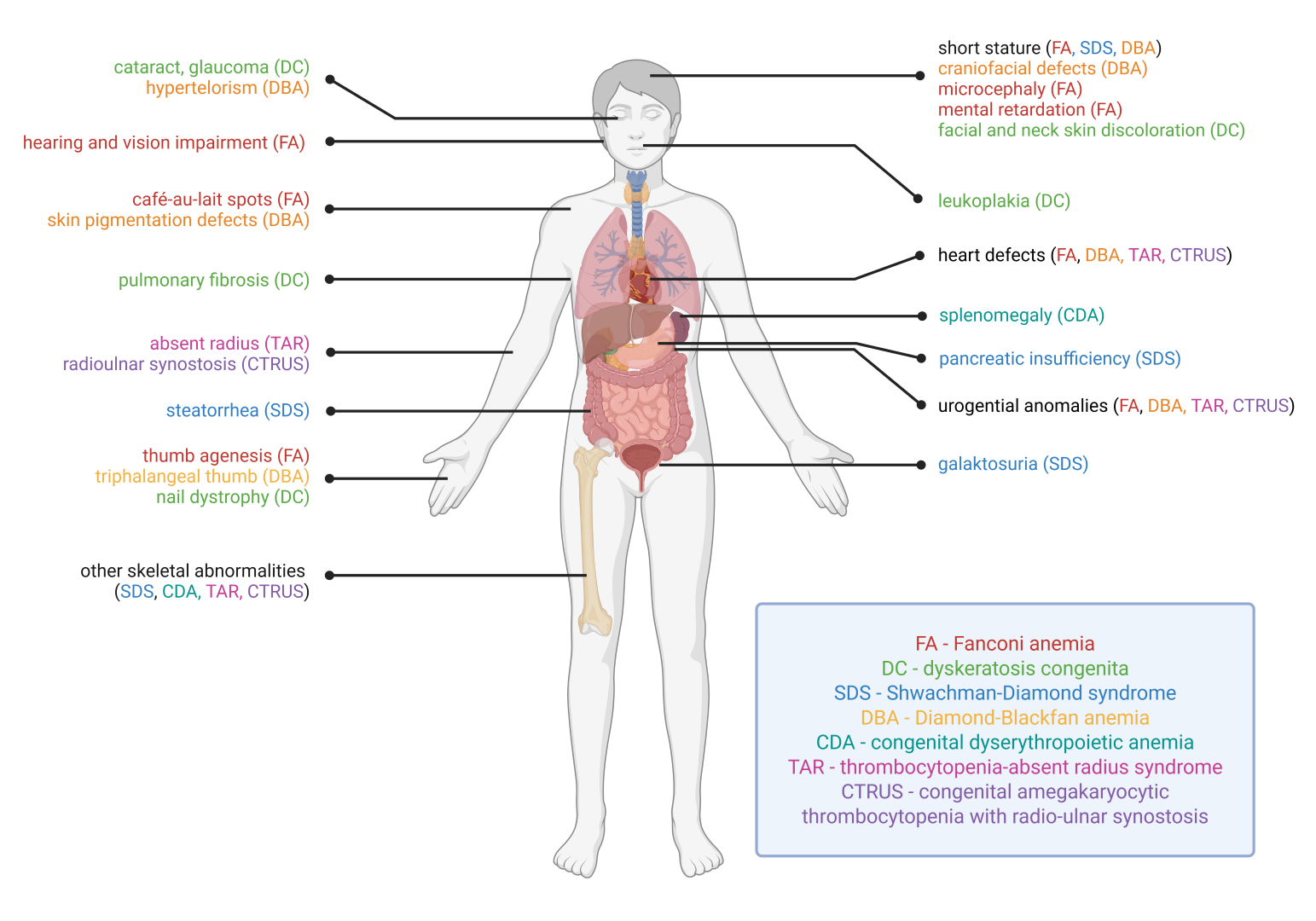
IBMFs are among the most serious hematological diseases of childhood. Bone marrow failure manifests as pancytopenia. Inadequate erythropoiesis results in anemia, which can lead to the need for red blood cell transfusions and its complications (secondary hemochromatosis). Impaired platelet production leads to impaired primary hemostasis and a tendency to bleed. The lack of white blood cell production and their functional impairment lead to life-threatening infections. A significant proportion of IBMFs are also associated with a risk of progression to myelodysplastic syndrome (MDS) and acute myeloid leukemia (AML), which typically have an aggressive clinical course. The risk of progression to MDS/AML varies among different IBMFs, and predicting individual risk is difficult. Additionally, some IBMFs also exhibit extrahematologic manifestations, including those affecting the nervous, circulatory, endocrine, gastrointestinal, and skin systems. Classic IBMFs include Fanconi anemia (FA), dyskeratosis congenita (DC) and related telomeropathies (TBDs), Diamond-Blackfan anemia (DBA), Shwachman-Diamond syndrome (SDS), and severe congenital neutropenias. New, very important syndromes include GATA2 and SAMD9/SAMD9L deficiency. Some of these syndromes share many features with primary immunodeficiencies and even appear in classifications of inborn errors of immunity (IEIs). IBMFs also include certain congenital thrombocytopenias, particularly congenital amegakaryocytic thrombocytopenia (CAMT) and thrombocytopenias associated with the risk of transformation to acute leukemia.

Increased genetic diagnostics, along with the growing number of characterized patients, are leading to the description of new phenomena such as somatic reversion, associated with spontaneous correction of hematopoiesis due to secondary/compensatory somatic defects in some patients, such as in genetic SAMD9/L dysfunction or Shwachman-Diamond syndrome.

Currently, cure is only possible with allogeneic hematopoietic stem cell transplantation (alloHSCT), which involves the complete replacement of the hematopoietic system with one rebuilt from donor stem cells.
Disease nameInheritance patternIncidenceCausative genesHematological symptomsPredisposition to carcinogenesisTreatment of hematological symptoms
Fanconi anemiamainly AR; less frequently AD (only FANCR), XLR (only FANCB)1 in 160,000-360,000 live births FANCA (~65%), FANCC (~10%), FANCG (~10%), rzadziej: FANCB, FANCD1, FANCD2, FANCE, FANCF, FANCI, FANCJ, FANCL, FANCM, FANCN, FANCO, FANCP, FANCQ, FANCR, FANCS, FANCT, FANCU, FANCV, FANCWsingle-line cytopenia, AA (~90% of patients under 40 years of age)MDS/AML (~700-fold higher than in the general population); squamous cell carcinoma, especially in the head and neck region; also esophageal, liver, and reproductive system cancersHSCT (the only long-term treatment option); androgens, G-CSF, transfusions, TPO-RAs; experimental: gene therapy, metformin, flavonoids and antioxidants
dyskeratosis congenitaXLR (DKC1 only), AD, AR1-9 per 1,000,000 live birthsDKC1 (~25%), TINF2 (~12%), TERC (~5%), less frequently: TERT, NOP10, NHP2, TCAB1, USB1, CTC1, RTEL1, ACD, PARN, NAF1, ZCCHC8, NPNM1, MDM4; in ~30% the defect is unknownsingle-line cytopenia, AA (~80% of patients; mainly in the 2nd and 3rd decade of life)MDS/AML; also squamous cell carcinoma of the head, neck, and anogenital region; less frequently, liver tumorsHSCT (long-term treatment option only); androgens, G-CSF, EPO, TPO-RAs, transfusions; gene therapy in clinical trials
Shwachman-Diamond syndromeAR, AD (SRP54 only)1 in 75,000-100,000 live birthsSBDS (classic subtype, in >90% of patients), other SDS-like genes: DNAJC21, EFL1, SRP54single-line cytopenia (most often neutropenia, less frequently anemia or thrombocytopenia (in 30-50% of patients)), AA (20-40% of patients)hematological: MDS/AML (in 10-30% of patients); rarely sarcomas and gastrointestinal cancersHSCT (mainly in case of progression to MDS/AML), G-CSF, transfusions
Blackfan-Diamond anemiaAD, XLR (applies to GATA1, TSR2)5-7 per 1,000,000 live birthsRPS19 (~25%), RPL5 (~7%), RPS26 (~7%), RPL11, RPL35A, RPS10, RPS24, RPS17, RPL15, RPS7, RPS28, RPS29, RPS26, RPS15, RPS27, RPL9, RPL18, RPL27, RPL31, GATA1, TSR2; ~25% unknown defectanemia, rarely bilinear cytopenia or pancytopeniararely MDS/AML (~3%)HSCT (the only treatment option), steroids, RBC transfusions (iron chelation); experimental: leucine, metoclopramide, metformin, TPO-RAs, calmodulin inhibitors, gene therapy
congenital dyserythropoietic anemiaAR (type I-II), AD (type III)1-9 per 1,000,000 live birthstype I: CDAN1, CDIN1, type II: SEC23B, type III: KIF23, others: KLF1limited to anemianot recordedTransfusions (iron chelation), HSCT, splenectomy, interferon-α; experimental: luspatercept, sotatercept, mitapivat (pyruvate kinase activator), gene therapy
congenital severe neutropeniaAD (ELANE, GFI1), AR1 in 200,000-300,00 live birthsELANE (~60%), HAX1 (~15%), G6PC3 (~5%), less frequently: GFI1, VPS45, CSF3R, JAGN1mainly isolated neutropeniaMDS/AML (15-20% cumulative risk of progression)G-CSF, HSCT (if no response to G-CSF or progression to MDS/AML)
congenital megakaryocytic thrombocytopeniaAD, AR1-4 per 1,000,000 live birthsMPL, THPO, RBM8A, MECOM, HOXA11mainly isolated thrombocytopenia, progression to AA most often in the case of the variant in MPL, THPOMDS/AML (mainly MECOM, HOXA11)HSCT, TPO-RAs (especially with the THPO variant, ineffective in MPL)
AR – autosomal recessive, AD – autosomal dominant, XLR – X-linked recessive, AA – aplastic anemia, MDS – myelodysplastic syndromes, AML – acute myeloid leukemia, HSCT – hematopoietic cell transplantation, G-CSF – granulocyte colony-stimulating factor, TPO-RAs – thrombopoietin receptor agonists, EPO – erythropoietin, RBC – packed red blood cells
Privacy Overview

This website uses cookies so that we can provide you with the best user experience possible. Cookie information is stored in your browser and performs functions such as recognising you when you return to our website and helping our team to understand which sections of the website you find most interesting and useful.